Effects of Social Norms and Social Networks on Non-Smoking Behavior among Junior High School Adolescents in Boyolali, Central Java, Indonesia
DOI:
https://doi.org/10.26911/thejhpb.2026.11.02.06Abstract
Background: Smoking behavior among adolescents remains a public health problem that may lead to long-term health consequences. Junior high school students are a vulnerable population at risk of engaging in smoking behavior due to social environmental influences, particularly from peers and family members. Social norms and social networks play an important role in shaping adolescents’ ability to maintain non-smoking behavior. This study aimed to analyze the effects of social norms and social networks on non-smoking behavior among junior high school students in Boyolali Regency.
Subjects and Method: This study employed a quantitative research method with a cross-sectional design. The population consisted of 33,700 junior high school adolescents in Boyolali Regency. A total of 240 respondents were included in this study, and the data were collected using a stratified random sampling technique. The samples were obtained from eight junior high schools in Boyolali Regency, comprising four public junior high schools and four private junior high schools.
Results: Based on Table 4, social norms had a significant effect on non-smoking behavior. Respondents with high social norms were 7.34 times more likely to engage in non-smoking behavior than those with low social norms (AOR = 7.34; 95% CI = 3.48 to 15.49; p = 0.001). Social networks also had a significant effect on non-smoking behavior. Respondents with high social networks were 7.78 times more likely to engage in non-smoking behavior than those with low social networks (AOR= 7.78; 95% CI= 3.68 to 16.43; p= 0.001). Gender was significantly associated with non-smoking behavior. Female respondents were 2.52 times more likely to engage in non-smoking behavior than male respondents (AOR = 2.52; 95% CI = 1.22 to 5.21; p = 0.012).
Conclusion: Social norms and social networks significantly influenced non-smoking behavior among junior high school adolescents in Boyolali Regency.
Keywords:
Social norms, social networks, non-smoking behavior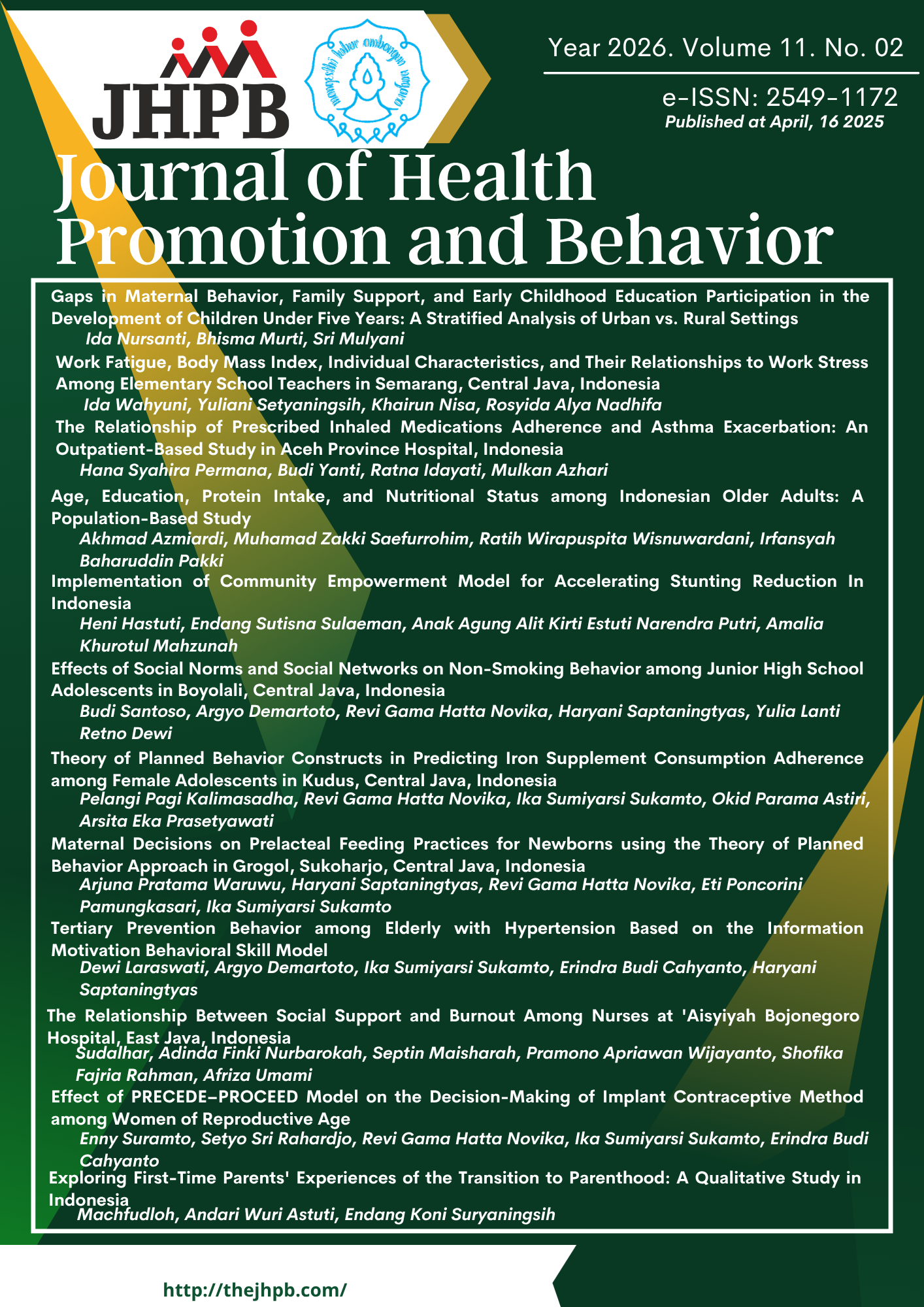
How to Cite
References
Cui Y, Zhu Q, Lou C, Gao E, Cheng Y, Zabin LS, Emerson MR. (2018). Gender differences in cigarette smoking and alcohol drinking among adolescents and young adults in Hanoi, Shanghai, and Taipei. J Int Med Res. 46(12): 5257–5268. DOI: 10.1177/0300060-518807292.
Fithria F, Adlim M, Jannah SR, Tahlil T. (2021). Indonesian adolescents' pers-pectives on smoking habits: A quali-tative study. BMC Public Health. 21: 82. DOI: 10.1186/s12889-020-10090-z.
Gaol ML, Butar Butar M, Nasution HS, Sari P, Putra AN. (2024). Faktor-faktor yang mempengaruhi perilaku mero-kok pada remaja laki-laki di SMP Ne-geri 23 Merangin Tahun 2024. J Kesehat Tambusai. 6(2). DOI: 10.310-04/jkt.v6i2.43912.
Gong LG, Zhang Z, Wang LW, Rong ZR. (2026). Study on adolescents’ smo-king intentions: The influence of peer smoking and mediating roles of beli-efs and attitudes toward smoking be-havior. Front Public Health. DOI: 10.3389/fpubh.2026.1775438.
Islam KF, Awal A, Mazumder H, Munni UR, Majumder K, Afroz K, et al. (2023). Social cognitive theory-based health promotion in primary care practice: A scoping review. Heliyon. 9(4): e14889. DOI: 10.1016/j.heliy-on.2023.e14889.
Kamke K, Sabado-Liwag M, Rodriguez EJ, Pérez-Stable EJ, El-Toukhy S. (2020). Adolescent smoking susceptibility: Gender-stratified racial and ethnic differences, 1999–2018. Am J Prev Med. 58(5): 666–674. DOI: 10.10-16/j.amepre.2019.11.023.
Ministry of Health of Indonesia (2023). Survei Kesehatan Indonesia 2023. [in Indonesian language].
Listyorini PI. (2023). Analisis perilaku me-rokok berdasarkan data Badan Pusat Statistik Provinsi Jawa Tengah tahun 2021: Perokok usia 15–24 tahun di eks-Karesidenan Surakarta termasuk Kabupaten Boyolali. Surakarta: Uni-versitas Muhammadiyah Surakarta.
Littlecott HJ, Moore GF, Moore L, Lyons RA, Murphy S. (2023). Perceptions of friendship, peers and influence on adolescent smoking behaviour. BMC Public Health. 23: 120. DOI: 10.11-86/s12889-022-14727-z.
Liu J, Zhao S, Chen X, Falk E, Albarracín D. (2017). The influence of peer behavior as a function of social and cultural closeness: A meta-analysis of norma-tive influence on adolescent smoking initiation and continuation. Psychol Bull. 143(10): 1082–1115. DOI: 10.1-037/bul0000115.
Loan CM, Khurana A, Wright J, Romer D. (2021). Selection versus socialization effects of peer norms on adolescent cigarette use. Tob Use Insights. 14: 1–8. DOI: 10.1177/1179173X211066005.
Montes F, Blanco M, Useche AF, Sanchez-Franco S, Caro C, Tong L, et al. (20-23). Exploring the mechanistic path-ways of how social network influences social norms in adolescent smoking prevention interventions. Sci Rep. 13(1): 3017. DOI: 10.1038/s41598-023-28161-7.
Park M, Song H. (2022). Impact of self-con-trol and social network of friends on the amount of smoking among out-of-school youth. Healthcare (Basel). 10(11): 2138. DOI: 10.3390/health-care10112138.
Pradana A, Nugroho B, Sari D, Putri R. (2025). Analisis sistematis faktor so-sial dalam perilaku merokok pada re-maja dan implikasinya terhadap kese-hatan. J Kesehat Masy Indones. 2(4): 97–124. DOI: 10.62017/jkmi.v2i4.4-804.
Ramadhini N. (2025). Pola interaksi sosial dan perilaku merokok di kalangan siswa sekolah menengah pertama. Psyche 165 J. 18(1): 32–40. DOI: 10.35134/jpsy165.v18i1.465.
Scalici F, Schulz PJ. (2017). Influence of perceived parent and peer endor-sement on adolescent smoking inten-tions: Parents have more say, but their influence wanes as kids get older. PLoS One. 12(7): e0181542. DOI: 10.1371/journal.pone.0181542.
Statistics of Central Java Province (2021). Statistik Provinsi Jawa Tengah 2021. [in Indonesian language].
Valente TW. (2025). Social network influ-ences on adolescent substance use. Addict Behav Rep. DOI: 10.10-16/j.socscimed.2025.118290.
World Health Organization. (2023). WHO Report on the Global Tobacco Epide-mic 2023: Protect People from To-bacco Smoke. Geneva: World Health Organization.
World Health Organization. (2024). Pre-valence of Tobacco and E-Cigarette Use by Young People. Copenhagen: WHO Regional Office for Europe.
Zumrotussholikhah L, Haiya NN, Ardian I. (2025). Dukungan lingkungan sosial berhubungan dengan perilaku mero-kok pada remaja. Sanitas J Health Med Psychol Stud. 1(2): 227–237. DOI: 10.65310/6aqaqp18.