Analysis of Factors Influencing Community Participation in the Free Health Screening Program Based on the Precede–Proceed Model
DOI:
https://doi.org/10.26911/thejhpb.2026.11.03.04Abstract
Background: Free health screening programs (Program Pemeriksaan Kesehatan Gratis/PKG) are essential promotive and preventive strategies to improve public health through early disease detection. However, community participation remains suboptimal despite the availability of free services. This study aimed to analyze factors influencing community participation based on the PRECEDE–PROCEED model.
Subjects and Method: This was an analytic cross-sectional study conducted in six public health centers in Sragen Regency, Central Java, Indonesia. The target population was community members aged ≥15 years who were eligible for the PKG program. A total of 264 respondents were selected using simple random sampling. The dependent variable was community participation in the PKG Program. Independent variables included predisposing factors (knowledge, attitude, motivation), enabling factors (facilities, ease of access, service information), and reinforcing factors (social support). Data were collected using a structured questionnaire and analyzed using the Chi-Square test and multiple logistic regression.
Results: Multivariate analysis showed that respondents with easy access to health services were 4.40 times more likely to participate in the PKG Program than those with difficult access (OR= 4.40; 95% CI=1.41 to 13.72; p=0.011). Respondents with high social support were 22.03 times more likely to participate than those with low social support (OR= 22.03; 95% CI=4.59 to 105.74; p <0.001). Although not statistically significant, facilities showed a borderline association with participation (OR=0.02; 95% CI=0.0002 to 1.39; p=0.070). Social support was the most dominant factor influencing participation.
Conclusion: Community participation in the PKG Program was relatively high. Social support was the strongest determinant of participation, while ease of access significantly influenced participation. Although not statistically significant, the availability of facilities showed a borderline association and may contribute to improving community participation.
Keywords:
community participation, health screening, social support, access, health behavior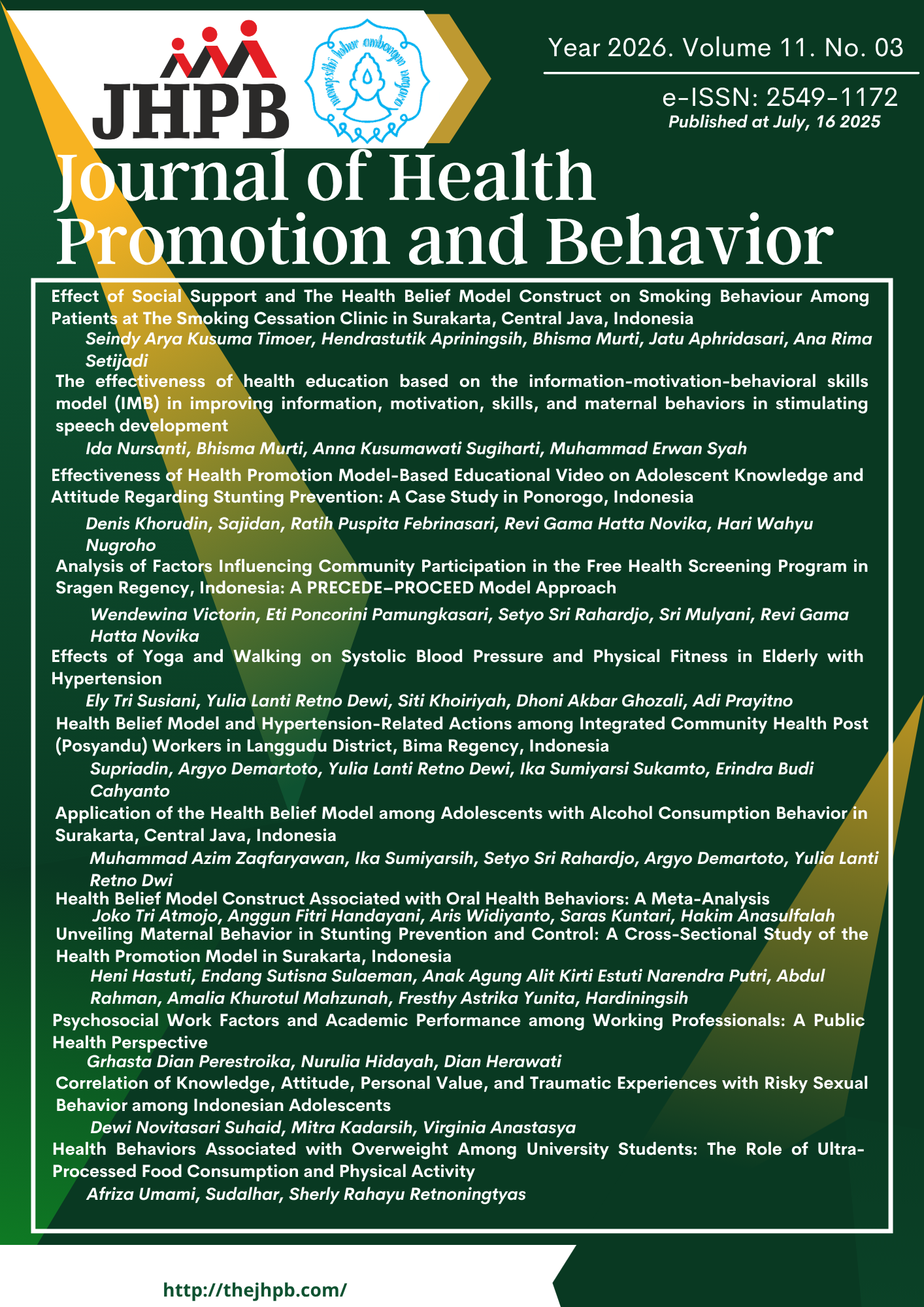
How to Cite
References
Al-Worafi YM (ed.) (2024). Handbook of medical and health sciences in developing countries. Cham: Springer.
Anggraini N (2023). Healthcare access and utilization in rural communities of Indonesia. J Community Health Provision. 3(1). https://doi.org/10.55-885/jchp.v3i1.214.
Arulselvan G, Chidambaram S, George N, Rizvana S, Narayan P, Annamalai P, Vadarariayan PHR, et al. (2024). Preventive health checkup: Utilization, motivators, and barriers among the general population in a rural district in Tamil Nadu, India. Cureus. 16(1): e52529. https://doi.org/10.775-9/cureus.52529.
Chhetri Y, Khatri D, Gahatraj NR (2023). Health service utilization and its determinants among senior citizens in the semiurban area of Western Nepal: A cross-sectional study. J Aging Res. 2023: 3655259. https://doi.org/10.1155/2023/3-655259.
Crosby RA, Noar SM (2021). What is a planning model? An introduction to PRECEDE-PROCEED. In: Health behavior theory for public health. J Public Health Dent. https://doi.org/-10.1111/j.1752-7325.2011.00235.x.
Fitri U, Arumsari I, Ningtyas LN (2024). PRECEDE-PROCEED model dalam menentukan pola konsumsi ultra-processed food pada dewasa muda di wilayah urban. ARGIPA. 9(1): 43–52. https://doi.org/10.22236/argipa.v9i1.13301.
Glanz K, Rimer BK, Viswanath K (2016). Health behavior: Theory, research, and practice. 5th ed. San Francisco: Jossey-Bass.
Garcia RP, Vazquez AS, del Rio Lanza AB (2025). The promotion of preventive behaviours in healthcare services: A quantitative study among older adults in Spain. J Eval Clin Pract. 31(4): e70108. https://doi.org/10.1111/jep.7-0108.
Green LW, Kreuter MW (2018). Health program planning: An educational and ecological approach. 4th ed. New York: McGraw-Hill Education.
Hair JF, Black WC, Babin BJ, Anderson RE (2019). Multivariate data analysis. 8th ed. Andover: Cengage Learning.
Idris H, Damaiasa RF, Hasyim H (2025). Healthcare utilization patterns in Indonesia: Insights from the 2023 National Socioeconomic Survey. Glob Health J. 9(4): 285–290. https://doi.-org/10.1016/j.glohj.2025.12.004.
Ipa M, Laksono AD, Wulandari RD (2023). The role of travel time on hospital utilization in the islands area: A cross-sectional study in the Maluku region, Indonesia, in 2018. Indian J Community Med. 48(2): 269–273. https://-doi.org/10.4103/ijcm.ijcm_229_22.
Ministry of Health of the Republic of Indonesia (2025). Decree of the Minister of Health of the Republic of Indonesia No. HK.01.07/MENKES/33/2025 on the Technical Guidelines for the Free Health Check-up Program. Jakarta, Indonesia: Ministry of Health of the Republic of Indonesia.
Khami L, Motalebi SA, Mohammadi F, Momeni M, Shahrokhi A (2020). Can social support predict health-promoting behaviors among community-dwelling older adults?. Asian J Soc Health Behav. 3(1): 22–26. https://-doi.org/10.4103/SHB.SHB_50_19.
Masjadi, Astuti R, Chakim I, Prasetyaningsih M (2025). Edukasi kesehatan dan peningkatan cakupan pemeriksaan kesehatan gratis di Puskesmas Tunjungan Blora. J Inov Pengabdi Masy Indones. 4(3): 145–149. https:-//doi.org/10.26714/jipmi.v4i3.788.
Mayasari E, Yunita J, Mitra M, Leonita E, Mianna R, Sari NP, et al. (2025). Sosialisasi pemeriksaan kesehatan gratis (PKG) sebagai upaya meningkatkan kesejahteraan masyarakat. J Medika. 4(2): 70–75. https://doi.org/10.31004/29qjq237.
McKenzie JF, Neiger BL, Thackeray R (2017). Planning, implementing, and evaluating health promotion programs: A primer. 7th ed. Boston: Pearson Education.
Nur'Ilmi A, Manglapy YM, Iftita MA, Askar MA (2025). Factors associated with community visits to integrated non-communicable diseases development posts (Posbindu PTM). J Promot Kesehat Indones. 20(2): 125–131. https://doi.org/10.14710/jpki.20.2.125-131.
Oktaria V, Mahendradhata Y (2022). The health status of Indonesia's provinces: The double burden of diseases and inequality gap. Lancet Glob Health. 10(11): e1547–e1548. https://doi.org/10.1016/S2214-109X(22)00405-3.
Sulaeman ES, Murti B, Waryana (2015). Aplikasi model pada perencanaan program pemberdayaan masyarakat bidang kesehatan berbasis penilaian kebutuhan kesehatan masyarakat. J Kedokt Yars. 23(3): 149–164. https://doi.org/10.33476/jky.v23i3.230.
Tu H, Zhang L, Xu M, Zhao Z, Han J, Yan L (2024). The mediating effect of self-efficacy on social support and cancer screening behavior among Chinese women: A cross-sectional study. BMC Womens Health. 24(1): 454. https://doi.org/10.1186/s12905-024-03296-5.
Wahyuningsih HP, Murti B, Lestari E, Reviono, Margono, Putri DF (2022). The influence of implementation of Health Promotion Model PRECEDE-PROCEED towards growing child, nutritional status, and quality of life of children. Indones J Pharm. 33(1): 34–41. https://doi.org/10.22146/ijp.2473.
WHO (2020). Community engagement: A health promotion guide for universal health coverage in the hands of the people. Geneva: World Health Organization.
Yücekaya MA, Uğraş S, Sagin AE, Çetin A, Iconomescu TM, Talaghir LG (2025). Relationships among social support, healthy lifestyle beliefs, physical lite-racy, and enjoyment of physical acti-vity: A moderated mediation model. Front Public Health. 13: 1617124. https://doi.org/10.3389/fpubh.2025.1617124.