Effect of Social Capital on Tertiary Preventive Behavior among Older Adults with Type 2 Diabetes Mellitus: A Structural Equation Modeling Approach
DOI:
https://doi.org/10.26911/thejhpb.2025.10.04.10Abstract
Background: Diabetes Mellitus (DM), known as the “silent killer,” continues to show an increasing number of cases. It has emerged as one of the most serious and common chronic diseases, leading to life-threatening complications, disability, and reduced life expectancy. The persistently high prevalence of diabetes in Karanganyar Regency, along with the interaction among multiple determinants, underlies the objective of this study, which is to analyze the influence of structural, cognitive, and relational social capital models on tertiary preventive behavior among elderly individuals with Type 2 Diabetes Mellitus.
Subjects and Method: This study employed a cross-sectional design. It was conducted in Karanganyar Regency (Jatipuro, Jatiyoso, and Karanganyar sub-districts), Central Java, from January to March 2025. A total of 210 elderly participants were selected using certified random sampling. Data were collected using a structured questionnaire. The analyses included univariate, bivariate, and multivariate analyses using a structural equation model (SEM). The dependent variable was tertiary preventive behavior among elderly individuals with Type 2 Diabetes Mellitus. The independent variables were social capital, comprising structural social capital, cognitive social capital, and relational social capital.
Results: Structural social capital had a positive and statistically significant effect on tertiary preventive behavior (b= 0.32; 95% CI= 0.13 to 0.52; p= 0.001). Relational social capital also showed a positive and significant effect on tertiary preventive behavior (b= 0.37; 95% CI= 0.15 to 0.59; p= 0.001). Age demonstrated a negative and statistically significant effect on tertiary preventive behavior (b= -0.09; 95% CI= -0.16 to -0.03; p= 0.003).
Conclusion: The findings of this study indicate that elderly individuals with Type 2 Diabetes Mellitus who have higher levels of social capital—comprising structural, cognitive, and relational dimensions—are more likely to engage in tertiary preventive behaviors.
Keywords:
structural equation model, elderly, type 2 diabetes mellitus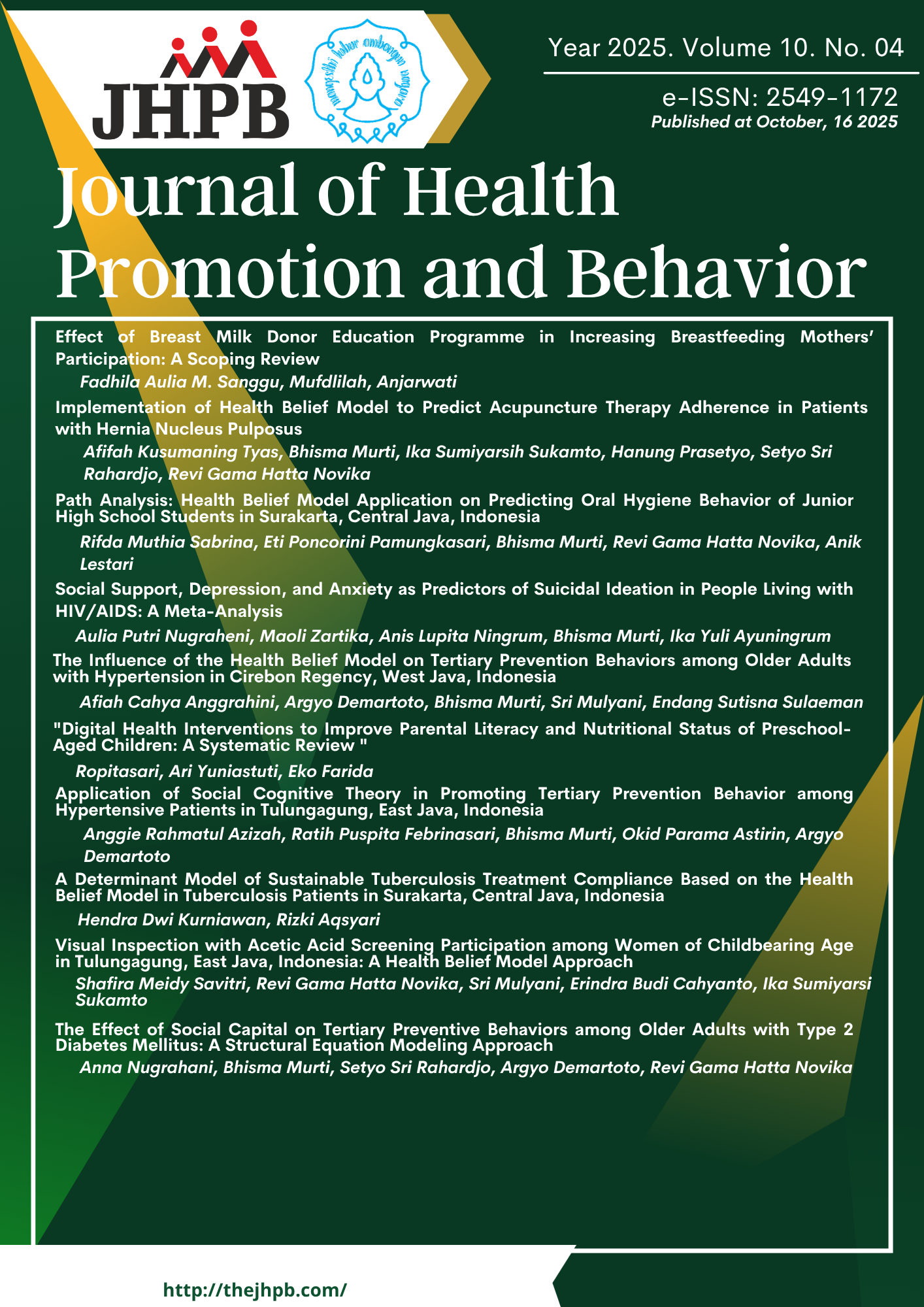
How to Cite
References
American Diabetes Association. (2023). Standards of medical care in diabetes 2023. Diabetes Care. 46(Suppl 1): S1–S291. doi: 10.2337/dc23-SINT.
Chen YM, Lin HS, Lin PY. (2017). Self-care behaviors of older people with chronic disease: a longitudinal study. J Nurs Res. 25(5): 368–375. doi: 10.1097/jn-r.0000000000000189.
Claridge T. (2018). Dimensions of social capital: structural, cognitive, and rela-tional. Soc Cap Res. 1: 1–4.
Farina E, Riva M, Pruneri F, Malnati M. (2020). Social support and quality of life in older adults: the role of inter-personal relationships. Aging Ment Health. 24(10): 1653–1660. doi: 10.1-080/13607863.2019.1622620.
Gao M, Wang C, Sun X. (2020). Social capital and health in older adults: a systematic review and meta-analysis. Arch Gerontol Geriatr. 91: 104236. doi: 10.1016/j.archger.2020.104236.
Ghozali I. (2016). Aplikasi analisis multi-variate dengan program IBM SPSS 23. Badan Penerbit Universitas Dipo-negoro.
Hair JF, Black WC, Babin BJ, Anderson RE. (2014). Multivariate data analysis. 7th ed. Pearson Education.
International Diabetes Federation. (2022). IDF diabetes atlas: global, regional and country-level diabetes prevalence estimates for 2021 and projections for 2045. Diabetes Res Clin Pract. 183: 109119. doi: 10.1016/j.diabres.202-1.109119.
Islam MR, Walk M. (2020). Community social capital and individual social capital: a study on their interrelati-onship and roles in disaster recovery. Int J Disaster Risk Reduct. 50: 10-1735. doi: 10.1016/j.ijdrr.2020.101-735.
Jian C, Peng X, Tian H, Ding Q (2026). The influence of social support on active aging in chronic disease patients among older adults: mediating role of coping strategies. Front Public Health. 14:1747285. https://doi.org/-10.3389/fpubh.2026.1747285.
Kementerian Kesehatan Republik Indone-sia. (2018). Laporan nasional riset kese¬hatan dasar (Riskesdas) tahun 2018. Badan Penelitian dan Peng-embangan Kesehatan.
Kouvonen A, Vahtera J, Oksanen T, De Vogli R, et al. (2021). Chronic disease, so¬cial capital, and health-related quality of life among older adults. J Aging Health. 33(1–2): 3–15. doi: 10.117¬7/0898264320931900.
Kurniawan H, Dewi SR. (2023). Modal sosial dan kepatuhan pengobatan lansia de¬ngan penyakit kronis di wilayah per¬kotaan. J Geriatri Indo-nes. 7(1): 20–29.
Lazar A, Fingerman KL, Luo M. (2020). Per¬ceived fairness, trust, and social enga¬gement among older adults: implica¬tions for community health. Geron¬tologist. 60(6): 1092–1101. doi: 10.10¬93/geront/gnaa048.
Lee HY, Jang SN, Lee SA. (2021). Barriers to health care access and utilization among older adults: a cross-national study. Int J Environ Res Public Health. 18(2): 689. doi: 10.33¬90/¬ije-rph18020689.
Murti B. (2013). Prinsip dan metode riset epidemiologi. Gadjah Mada Univer-sity Press.
Nguyen HT, Pham T, Vu LH. (2020). Self-efficacy and health behaviors among the elderly with chronic diseases. BMC Geriatr. 20: 256. doi: 10.11-86/s12877-020-01626-w.
Notoatmodjo S. (2012). Promosi kesehatan dan perilaku kesehatan. Rineka Cipta.
Nurhasanah I, Sulastri F. (2022). Perilaku preventif lansia terhadap penyakit kronis ditinjau dari usia dan duku-ngan sosial. J Keperawatan Kesehat Masy. 11(2): 85–92.
Oliveira CDL. (2018). What is the association between social capital and diabetes mellitus? a systematic review. Diabe¬tes Metab Syndr Clin Res Rev. 12(4): 601–605. doi: 10.1016/j.dsx.2018.0¬3.021.
Perkins DD, Brown BB, Taylor RB. (2021). Social networks, neighborhood struc-tures, and community engagement. Community Dev J.
Pitas N, Ehmer C. (2020). Social capital in the response to COVID-19. Am J He-alth Promot. 34(5): 527–529. doi: 1-0.1177/0890117120924531.
Rahmawati I, Setiawan R, Kurniasih D. (2023). Modal sosial kognitif dan pe-nerimaan diri lansia penderita penya-kit kronis. J Keperawatan Kesehat Masy. 12(1): 14–23.
Setyawati R, Hidayati R, Mahendra A. (20-22). Pengaruh modal sosial terhadap partisipasi lansia dalam kegiatan ko-munitas: studi pada kelompok pos-yandu lansia. J Sos Humaniora Terap. 4(2): 112–124.
Syafei A, Darmaja S. (2019). Determinan ma¬najemen perawatan diri pasien diabe¬tes melitus tipe 2 di puskesmas Keca¬matan Ciputat, Kota Tangerang Sela¬tan. J Penelit Pengemb Pelayanan Ke¬sehat. 3(2): 73–85.
Wang Z, Fang Y, Zhang X. (2024). Impact of social capital on health behaviors of middle-aged and older adults in Chi-na: an analysis based on CHARLS 2020 data. Healthcare (Basel). 12(11): 1154. doi: 10.3390/healthcare121111-54.